
A jiu-jitsu gym is built on contradictions
Reflections from my conversation with Professor Marvin Castelle and Coach Kay from 10th Planet Torrance, CA
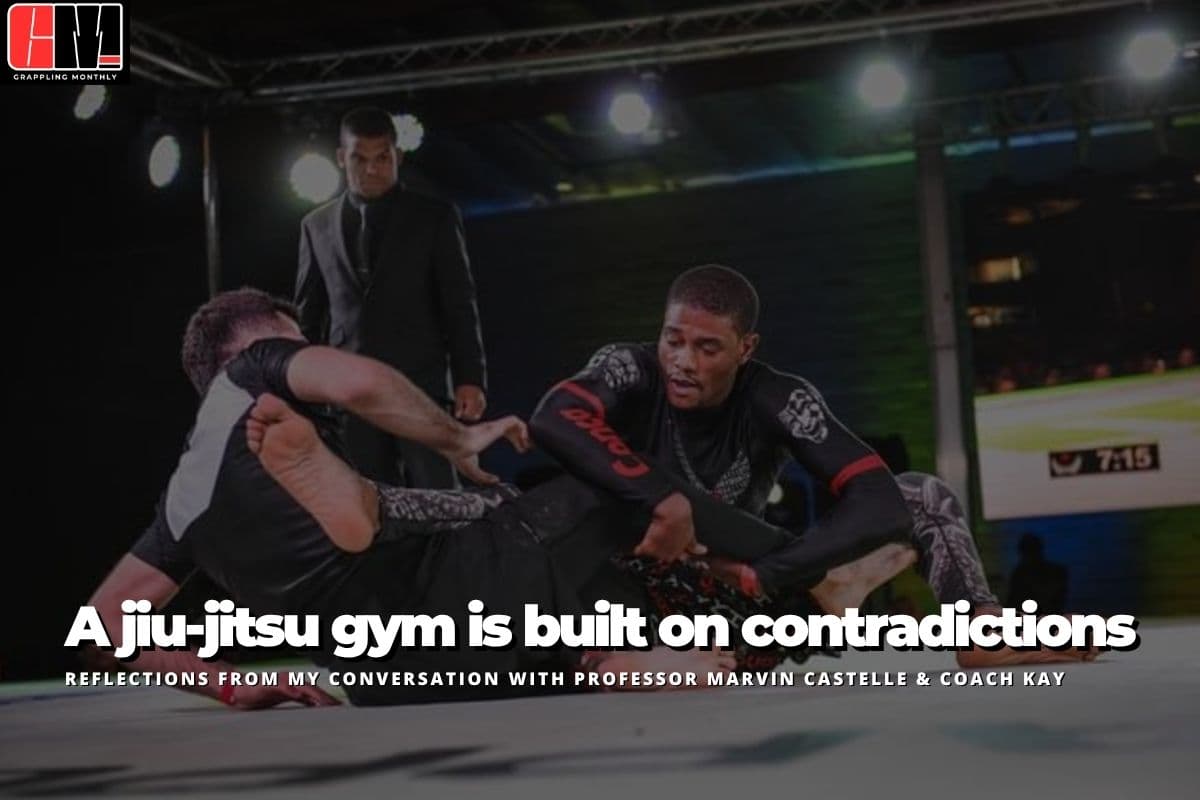
Reflections from my conversation with Professor Marvin Castelle and Coach Kay from 10th Planet Torrance, CA.
A gym is not simply a place where moves are taught in sequence until someone becomes competent. My conversation with Marvin Castelle and Coach Kay of 10th Planet Torrance pointed somewhere less obvious.
A gym is a place where incompatible demands have to live in the same room. People want self-defense without too much fear. They want progress without too much frustration. They want standards, but not standards so high that they feel shut out. They want a serious coach, but not one who makes the room feel hostile. They want a strong culture, but they also want freedom. The work is not only technical. It is managerial, social, psychological, and sometimes moral.
That is why running a gym can make a black belt feel like a beginner again.
The limits of mat competence
Coach Kay put it bluntly. In jiu-jitsu, you can form a game plan and it can work. In business, you can form a game plan, watch it fail, make another one, and watch that fail too. Being able to teach, roll, compete, and inspire trust on the mat does not automatically equip someone to run an operation, build a culture, manage expectations, retain members, and make the numbers work. Those are separate competencies. Sometimes they overlap. Often they do not.
What makes the problem harder is that the product itself is unstable.
A gym is not selling the same thing to everyone who walks through the door. One student wants to compete. Another wants exercise. Another wants confidence. Another wants to survive a bad situation. Another wants structure after a rough period in life. Another wants friends. Even the same student may want different things at different stages. Early on, they may want belonging. Later, they may want technical depth. Then they may want proof that they are not wasting their time.
Reading the room
This is where coaching stops being a matter of knowing more than the student. A room full of competitors can absorb one kind of class. A room full of working adults, anxious beginners, hobbyists, and a few future killers is another matter entirely. Professor Marvin talked about learning to change his delivery depending on the level of the class. Beginner classes call for one tone. Advanced classes allow another. That is not softening the art. It is understanding that information lands differently depending on the person receiving it.
A coach who came up in a hard environment often believes, not without reason, that intensity creates honesty. It strips away excuses. It reveals where a person is hiding from pressure. But intensity has a cost. Used badly, it creates resentment before it creates resilience. It can make a beginner associate jiu-jitsu with embarrassment rather than progress.
The opposite mistake is more common and, in some ways, more dangerous. A school gets so concerned with comfort and retention that it gives people a flattering version of the art. Students feel good, but their confidence rests on conditions that are too controlled to tell them much. Marvin kept returning to that tension. He wants people to be able to protect themselves. He also knows that many people are not ready for the level of intensity that shaped him. The problem is not choosing one or the other. Both demands are real, and the job is holding them in the same room at the same time.
Marvin spoke at length about live drills, ecological approaches, movement, detail, and the problem of trying to teach deep positions to people who do not yet have the body awareness or conditioning to make sense of them. The interesting part was not that he took a side and stayed there. It was that he kept circling the same practical question: what can this person absorb right now without being overwhelmed, misled, or stalled out? In practice, most coaches are not choosing between pure philosophies. They are trying to move a room forward with the students they actually have.
What rank is actually protecting
That makes the belt discussion more revealing than it first appears.
Marvin's decision to add a grey belt before blue in his own system is not a branding choice. It is an attempt to solve a problem. Blue belt is often treated as an early milestone, but it is also the point where weak foundations start to show. A student who has been moved along too quickly may wear the belt, but they do not feel like they inhabit it. Then they run into harder rooms, sharper competition, and more sophisticated games, and the gap becomes obvious. At that point the belt does not motivate. It exposes.
Rank only means something if it protects a standard. Otherwise it becomes customer service. A belt can represent time served, loyalty, attendance, political caution, or actual development. Those are not the same thing. Premature promotion is not kindness. It sets up a student to doubt themselves later, exactly when confidence is supposed to be catching up with skill.
Culture is not a byproduct
There is another layer here that gyms often prefer not to examine too closely. Culture is not a byproduct of instruction. It is part of instruction.
That includes the obvious things: how people are expected to train, how visitors are received, how rounds are managed, how coaches speak to students. It also includes less comfortable questions. What is considered acceptable behavior? What gets corrected early? What is tolerated because the person is talented, charismatic, or useful to the gym? What signals are sent by favoritism, boundaries with children, or the way complaints are handled?
Prof. Marvin and Coach Kay were direct about this. Their concern was that gyms can drift into permissiveness while telling themselves they are being relaxed, modern, or welcoming. But a room built on physical intimacy, hierarchy, admiration, and trust cannot afford much self-deception. The jiu-jitsu world likes to talk about lineage, loyalty, and brotherhood. It is less comfortable talking about screening, enforcement, or the ways power distorts behavior. Not because the subject is noble, but because it is unavoidable.
The moment a coach wants to be more than a technician, they are shaping a social environment. The moment they charge money, that environment becomes a product. The moment children, women, beginners, or vulnerable people enter the room, the stakes get higher. At that point, "we are all family here" is not enough. It may even be part of the problem, especially when it replaces clear accountability with emotional fog.
The strain of building honestly
What came through most clearly in this conversation was not a finished system. It was the strain of trying to build one honestly.
Prof. Marvin does not sound like someone who believes he has solved the equation. He sounds like someone who knows the equation is real. Technique still matters. It matters a lot. But technique needs a room where people can learn without being coddled, where they can be pushed without being needlessly broken down, where promotion still carries weight, and where culture does not get outsourced to vibes.
That is a harder job than teaching an armbar. It is also closer to the real work.
10th Planet Torrance runs classes Monday through Thursday and Saturday. Find them at www.10ptorrance.com or on Instagram at @10thplanettorrance. You can also reach Prof. Marvin directly at @marvincastelle10p.