
The Test Jiu-Jitsu Stopped Running
Reflections from my conversation with professor 6th degree black belt & founder of Brazilian Top Team Canada, Fabio Holanda.
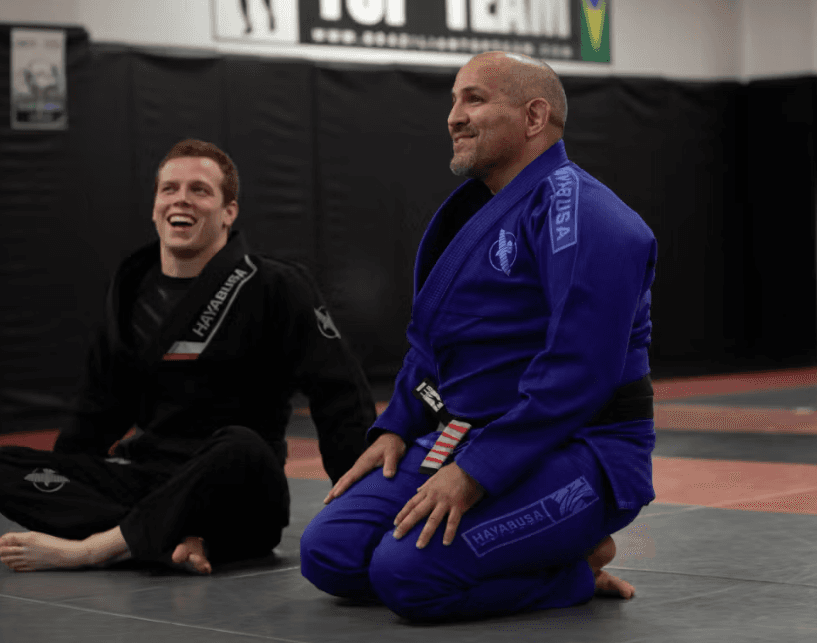
Reflections from my conversation with professor 6th degree black belt & founder of Brazilian Top Team Canada, Fabio Holanda.
Professor Fabio Holanda has run a Brazilian Top Team affiliate in Montreal for over twenty years. He trained under Carlson Gracie, Murilo Bustamante, and Mario Sperry, just to name a few, at the height of BTT's dominance. He has cornered professional fighters for most of his coaching career, including champions such as Georges St-Pierre and Brianna Ste-Marie. When he talks about positions, he is never only talking about positions.
When we talked about closed guard, he describes it as the safest place to be on bottom, and half guard as one of the most useful places to be on top. The reasoning for this belief? Trial and error helped provide the proof of both positions' effectiveness.
Brazilian Jiu-jitsu developed rapidly, under vale tudo (no holds barred fights), prior to becoming its own sport competition. Professor Holanda explains that, in a vale tudo context, jiu-jitsu prioritized devastating effectiveness. When the fighter is on top, control and positions that can quickly end a fight via strikes were king. If the jiu-jitsu fighter found themselves stuck on the bottom, they used closed guard to nullify most strikes until they could recover to an attacking position.
When jiu-jitsu formalized as a competitive sport and vale tudo evolved into regulated MMA, the selection pressures changed. Points were assigned to positions. Time limits were introduced. Strikes were removed from the grappling context entirely. Each of these changes was reasonable in isolation; sport requires structure, but collectively they created a competitive environment that rewards a different set of decisions than the one that produced the art's foundational positions.
This is not a criticism of sport jiu-jitsu. It is more an observation about how technical disciplines respond to their testing conditions.
The positions and approaches that persist in any competitive system are the ones that perform well within that system's specific constraints. Some of those positions are also structurally sound under broader adversarial conditions. Others are optimizations that degrade outside the environment that produced them. Sport competition, on its own, cannot always tell you which is which because the conditions that would reveal the difference have been removed from the test.
Professor Holanda's framework, inherited directly from Carlson Gracie and refined through decades of MMA coaching, is essentially a method for keeping that distinction legible. What does this position look like if someone can strike? What does this guard become if the opponent can't open it? These questions do not dismiss sport technique. They identify which elements of it are load-bearing and which are calibrated specifically to the ruleset.
About Half-Guard
Half guard is one illustration of how different testing conditions produce different conclusions about the same position. Professor Holanda mentioned in passing that half guard used to be called "half mount." The name encoded a specific understanding: on top in half guard, you are in a dominant position. One leg is trapped. The person underneath cannot rotate freely in either direction. Submissions are available that require neither full mount nor back control. The position does not look dominant the way full mount looks dominant, but it functions as a controlling position when read geometrically rather than symbolically.
Sport jiu-jitsu has elaborate top and bottom half guard systems but the position feels more transitional, something to move through on the way to a more legible hierarchy of positions that score big such as the mount and back control. In MMA however, top half guard stops strikes, controls mobility, and allows ground-and-pound. Its value was immediately felt because the conditions that would reveal a position's weaknesses were still present.
Khabib Nurmagomedov and Georges St-Pierre both spent large portions of their fights in top half guard, not due to a failure to pass their opponents' guards, but because the position gave them everything they needed and gave their opponents very little. They were in a position their opponents could not escape cleanly, could not strike from effectively, and could not mount offense against.
On the topic of closed guard
Professor Holanda described closed guard as "reverse full mount." If you think about it, from full mount, the bottom person's viable path runs entirely through escape, no submissions are realistically available, no dominant positions reachable without first solving the problem of being mounted.
From inside a closed guard, the person on top faces the same situation. Practically no submission is available. No dominant position is reachable without first solving the guard. The offensive inventory differs, mount concentrates strikes and submissions on the top person, closed guard distributes submission options toward the bottom person. Both positions trap one party in a problem whose only solution is escape.
This reframes what it means to play guard at a foundational level. In sport jiu-jitsu, many guards are viewed as an offensive position, you are capable of keeping your opponents stuck trying to find their balance while you are hunting sweeps and submissions. In the framework Professor Holanda inherited, closed guard is a survival position that is also offensive, in that order. Protection is primary. Sweeps and submissions follow from a stable base, not as the base itself. That ordering changes decision-making when the position deteriorates. When the closed guard weakens, a practitioner whose primary orientation is offensive reopens to recover attacking angles. A practitioner whose framework was developed against strikes is far more reluctant to open anything at all, because an open guard in that context is more of an exposure than purely an attacking position.
Professor Holanda was careful not to frame any of this as a verdict on modern sport practice. He trains competitors, respects the technical development that competition has driven, and does not argue that sport practitioners are doing something wrong. His position is more specific than that: the removal of striking from the grappling context eliminated a feedback mechanism that had previously kept certain structural realities visible. Positions that appear dominant under sport rules can be precarious under broader conditions, and positions that appear passive or overly conservative under sport rules can be precisely correct under broader ones. Without the adversarial pressure that makes the difference legible, practitioners can go a long time without knowing which category their techniques fall into.
As I write this, I am compelled to acknowledge certain modern jiu-jitsu fighters who have developed devastating games from the closed guard in gi and no-gi at the highest levels such as Brianna Ste-Marie & Mica Galvao.
The Carlson Gracie style, top pressure, control, pass and dominate, wasn't a stylistic preference. It was the direct product of vale tudo fighting and training MMA fighters for whom every position had to justify itself against someone actively trying to make it fail.
Professor Holanda's advice has not changed because the underlying test has not changed. Close the guard on bottom. Get to half guard on top. Not because these positions are old. Because they have been tested against conditions that produce honest answers, and they keep returning the same result.