
Jiu-jitsu exposes how badly most of us manage stress.
Reflections from my conversation with Dr. Diana Wang & Dr. Kris Martin of Open Mat Physio
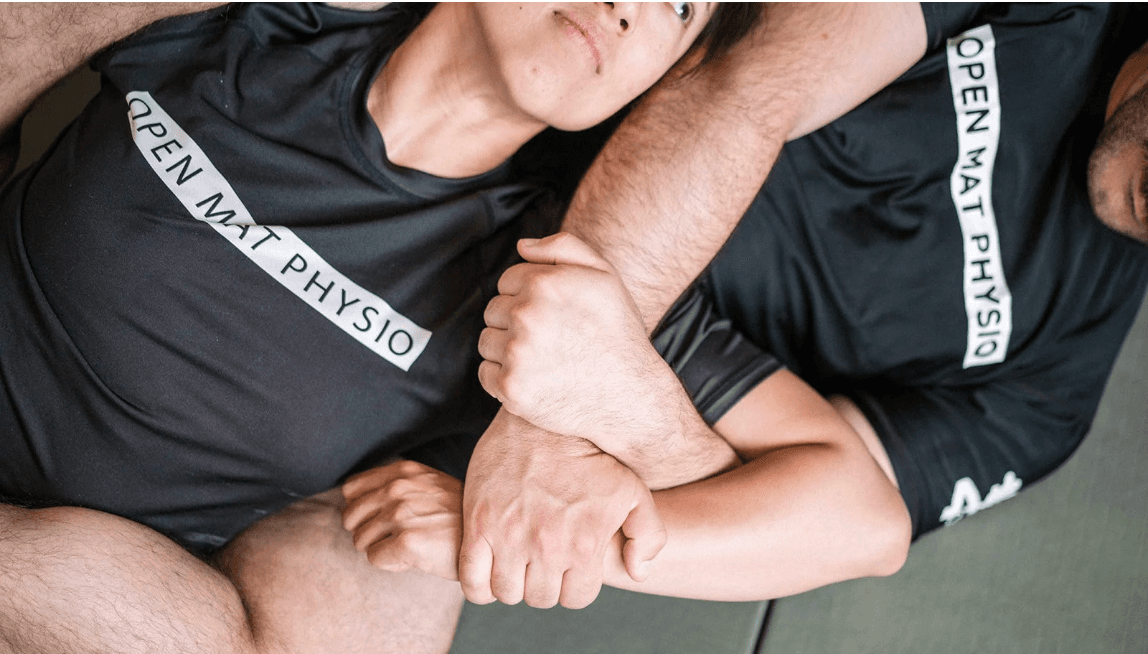
Reflections from my conversation with Dr. Diana Wang & Dr. Kris Martin of Open Mat Physio.
The familiar pattern
There is a recognizable cycle in grappling: something starts hurting -- a shoulder, elbow, knee, or lower back. Practitioners train through it because it is not catastrophic. They ice it, stretch it, maybe foam roll it. It settles just enough to convince them it is handled. Then they train hard again, it flares, and the cycle repeats.
Diana and Kris from Open Mat Physio illuminate this pattern not as a mystery, but as predictable and avoidable. They consistently point to a simpler explanation: many grapplers are not dealing with hidden, complex problems. Instead, they are overloaded, under-recovered, and seeking solutions in the wrong direction.
The culture of toughness
The jiu-jitsu culture rewards tolerance for discomfort. Practitioners take pride in being tough, showing up or competing despite injury. They train to avoid losing momentum, rounds, status, or the feeling of progress.
But toughness and judgment are not the same quality. The person who always pushes through is not necessarily the most disciplined -- sometimes they are simply the least honest about what their body can currently handle.
Physical therapy on a spectrum
One clear concept from their conversation: physical therapy belongs on a spectrum between pain management and sports performance, not confined to a narrow medical box. This reframing is useful for grapplers pursuing a sport that puts their joints, posture, nervous system, and recovery habits under pressure.
Treatment often gets imagined as passive and temporary -- you get hurt, gain some relief, regain range of motion, return to normal. But if your normal created the problem, you have only interrupted it, not solved it.
The overload problem
Dr. Diana Wang describes a scenario: a client with significant shoulder pain (7/10 regularly) still training six days a week who could not clearly distinguish between controlled drilling and chaotic, ego-driven rounds. That profile is not rare. In grappling, people often count attendance without counting cost. Two sessions get called training, but one might be intentional while the other is chaos. Treating these as equivalent is a fast path to chronic irritation and stalled progress.
Beyond passive tools
Diana and Kris remain skeptical of easy fixes. Massage, foam rolling, red light therapy, ice baths, and CBD have a place, but they are not central when someone consistently overloads themselves. The point is direct: passive tools cannot erase the consequences of a body that is always overworked.
Sleep matters enormously. Rather than simply telling people to sleep more, their approach is adjustment -- meeting people where they are, making changes small enough to stick, and moving gradually.
Physical durability requires real work
Durability is physical. If the posterior chain is weak, if someone is chronically folded forward, if the body struggles absorbing force outside preferred positions, it will eventually show. Their prescription is not glamorous: two short resistance sessions per week. Yet this does more for long-term resilience than endless searching for recovery gadgets.
Understanding as empathy
Many injured practitioners feel but rarely articulate well the pain of being misunderstood by providers unfamiliar with the sport. This is not merely about clinical knowledge -- it is about language and empathy. A generalist clinician may understand pain abstractly while missing what loss means to a committed grappler for whom not training disrupts routine, identity, stress management, social life, and personal pursuit.
Total system load
Jiu-jitsu problems can sometimes be overarching stress problems masquerading as sports injuries. Hard training is stress. Work is stress. Poor sleep is stress. Pain is stress. Anxiety around returning to full rounds is stress. When this accumulates without recovery space, the issue is not just tissue health -- it is total system load.
Open Mat Physio's philosophy is not to fix people, but to guide them through injury and provide tools for self-management.
The practical path forward
When practitioners honestly assess their training intensity, evaluate their rest quality, add basic strength work, warm up with intention, and stop treating returns from pain as green lights to sprint back to full intensity, they can find longevity and proactively mitigate injury risk while speeding recovery.
Find Open Mat Physio at www.openmatphysio.com or on Instagram at @openmatphysio.