
Beyond The Technique
What many academies are actually selling, whether they understand it or not, is a repeatable environment for confidence, structure, discipline, belonging, and change.
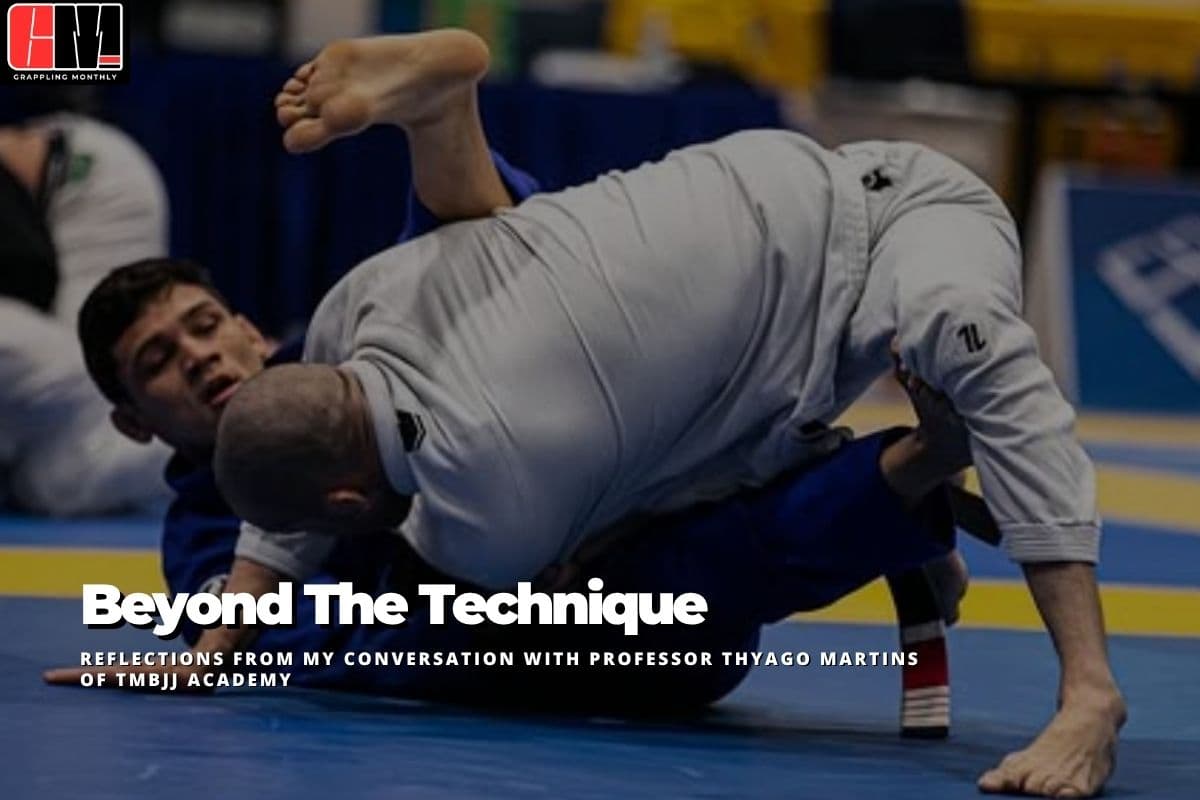
Reflections from a conversation with Professor Thyago Martins of TM BJJ Academy.
What does a jiu-jitsu academy provide beyond teaching physical techniques?
Techniques are what gets demonstrated in class, clipped for social media, and tested in competition. A student walks in expecting to learn how to pass, escape, submit, defend, and improve.
In my conversation with Professor Thyago Martins, another picture came into focus. A gym is not only a place where techniques are taught. It is a place where people learn how to carry themselves, how to regulate pressure, how to stay with difficulty, and how to build a life around something demanding without letting it destroy them.
What many academies are actually selling, whether they understand it or not, is a repeatable environment for confidence, structure, discipline, belonging, and change. That is a more serious offering than most people admit.
The Technique Is the Medium
On the surface, a student pays for access to instruction, classes, rounds, and progression. If the academy is competition-oriented, the value proposition expands to harder rounds, more specialized training, and a stronger relationship to the tournament scene. If the academy is broader in its approach, it may also promise fitness, self-defense, routine, or community.
To be clear, Professor Thyago Martins cares about technical development. He talks about concepts, timing, fundamentals, body type, grips, positional study, specific training, and the importance of paying attention to details. His jiu-jitsu is shaped by years of training, competition, coaching, and studying athletes whose games make sense for his frame. But what is striking in the conversation is that technical instruction is always connected to something larger.
Patience is not only a tactic for surviving a bad position. It is a way of thinking. Specific training is not only a drill format. It is a method for focused improvement. A white belt mindset is not only a nice slogan. It is a posture toward learning, business, language, and life. The academy, in this sense, is not merely a distribution point for techniques. It is a place where habits of attention are formed.
What People Are Really Buying
A lot of students say they joined jiu-jitsu to get in shape, learn self-defense, or challenge themselves. Those reasons are sincere, but they don't necessarily paint the whole picture.
Sometimes people need somewhere to put their anxiety. Sometimes they need to be around adults who are serious, respectful, and consistent. Sometimes they need a better relationship to discomfort.
The point of entry to jiu-jitsu often begins in vulnerability. What jiu-jitsu gives back is confidence.
For many students, that is how the value of training is first felt. Before they understand systems or strategy, they begin to feel more stable in themselves. They carry themselves differently. They panic less. They trust that pressure can be survived and worked through. A well-run academy creates the conditions for that change to happen repeatedly.
Patience as an Actual Product
Professor Thyago placed considerable emphasis on patience. He makes the point through jiu-jitsu, but applies it to life outside the academy. If someone passes your guard and you panic, you create more mistakes. If you try to solve the whole problem all at once, you usually make things worse. The answer is not passivity. The answer is step-by-step problem solving.
A student who trains long enough begins to internalize a few things: pressure is survivable, not every bad position is an emergency, frustration does not require panic, and progress is often incremental, not dramatic.
A lot of adults move through life without reliable ways to practice those skills. They encounter stress mostly through work, finances, health, family obligations, or private anxiety. Jiu-jitsu provides a structured place to meet discomfort with constraints. There is an opponent. There is fatigue. There is failure. There is confusion. But there is also a framework. That framework is one of the real products being sold.
The student is not just buying access to classes. They are buying repeated exposure to challenge in an environment where challenge can be made legible. That is where we start to understand jiu-jitsu's value well beyond the mat.
Culture Is Not Decorative
Professor Thyago speaks of humility, respect, openness, and of making sure everyone feels welcome. He talks about people from different affiliations coming through and about wanting the room to feel like home. He sees ego as an obstacle to learning and emphasizes the importance of being available, answering questions, and keeping the door open.
It would be easy to reduce this to vibe. What he is really describing is a set of management choices. Who feels comfortable asking questions? Who gets integrated and who gets ignored? How is authority expressed? What happens when new people walk in? What kind of emotional temperature does the instructor set?
These are not soft concerns. They shape retention, trust, learning, and word of mouth. They can affect whether a room becomes cliquish, performative, predatory, stagnant, supportive, or serious.
A lot of gym owners talk about community as though it emerges automatically from shared effort. It does not. Pressure can create camaraderie, but it can also create hierarchy, confusion, resentment, and silence if it is badly managed.
A deliberate culture is fostered. It is intentional, built through repetition, language, boundaries, and example.
"In Brazil we say: students are the professor's face." A room often takes on the habits of its leadership. If the instructor is unstable, ego-driven, careless, or hostile, that usually shows up in the student body. If the instructor is attentive, welcoming, demanding, and respectful, that tends to show up too.
What Matters
In the end, jiu-jitsu is less about titles and more about impact. Professor Thyago cites a student who arrived depressed and lost weight. He mentions a young man with gang involvement whose life began to move in a different direction. He mentions an 81-year-old student with serious health limitations whose movement, coordination, and function improved dramatically through training.
The student who becomes less isolated matters. The student who becomes more disciplined matters. The student who learns how to stay calm under pressure matters. The older student who recovers movement and confidence matters. The young person who finds a healthier identity around the mat than outside of it matters.
These are central outcomes that aren't measured in gold medals. A good academy changes lives in visible and invisible ways. Some changes appear on podiums. Many do not.
Considerations for Business Owners
If an owner understands that, beyond technique, jiu-jitsu offers structure, belonging, challenge, and transformation, they may ask themselves:
- What does the first month feel like for a beginner?
- What experience are people having before they understand the technical material?
- Is the room organized in a way that helps people stay long enough to improve?
- Are different ages and goals being accounted for intelligently?
- Is the academy producing confidence or merely sorting for toughness?
- Is the culture making people better, or only harder?
These questions affect retention, trust, referrals, and long-term reputation. They are also ethical questions.
The jiu-jitsu academy plays a role in how people understand themselves in relation to effort, hierarchy, physicality, and belonging. That power can be used badly. It can also be used well.
The Framework, the Rest Is Up to You
Jiu-jitsu can give you a framework for how to think: be patient, work hard, respect people, stay open, do not let ego block learning, keep building.
That does not mean jiu-jitsu automatically creates good lives. The sport contains its share of ego, dysfunction, abuse of power, and delusion, just like any other scene. But if you treat the art as a structure for becoming more capable and more useful, not just more skilled, that may be the deepest product a serious academy offers.
A way of organizing effort over time. A way of meeting pressure without collapsing. A way of belonging to something that asks for discipline and gives something back.
That is why the best academies tend to matter more to people than their monthly membership fee can explain. They are not only places people train. They are places people build and rebuild. The technique is the medium. The more profound results are born of what repeated training makes possible.