
Curriculum Shapes the Culture: What Professor Laercio Fernandes' Gym Operations Reveal About Retention
Most gyms do not lose students because their technique is slightly worse than the academy down the street. They lose students because the room feels unsafe, unpredictable, or built for someone else.
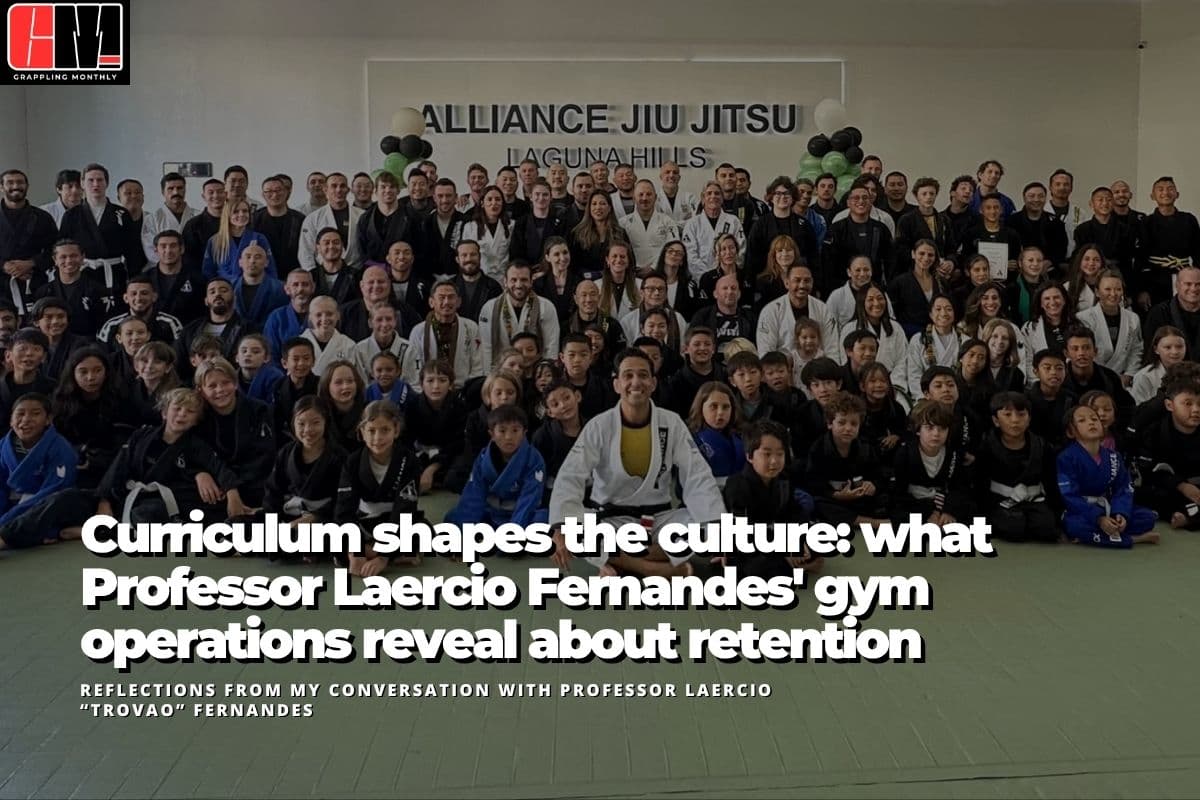
Reflections from a conversation with Professor Laercio "Trovao" Fernandes, founder and head instructor of Alliance Laguna Hills.
Written plans before the week starts. Weekly meetings. Segmented instruction inside the same hour. A curriculum that stays consistent but adapts based on what the team is missing. Professor Laercio's journey helped shape the blueprint he uses today.
Most gyms do not lose students because their armbar details are slightly worse than the academy down the street. They lose students because the room feels unsafe, unpredictable, or built for someone else.
Curriculum, in this sense, is more than a teaching preference. It is culture made visible.
The "Fight to the Death" Era Created Toughness, and Unnecessary Attrition
Professor Laercio is blunt about how it used to be. In Brazil, especially in the 90s and early 2000s, many rooms were built around pressure testing. You got roughed up early. If you stayed, you were welcomed. If you left, you were filtered out.
That approach did create toughness. It also created a high dropout rate that gyms tolerated because the pipeline never stopped.
The business reality in 2026 is different.
The average paying student is not a 19-year-old trying to become a competitor. The average paying student is an adult trying to integrate training into a life that already has work, stress, injuries, and responsibilities.
If your training model still depends on early attrition as a feature, you are running a sorting mechanism, not a development environment.
Toughness is not the same thing as durability. Modern gyms need durability.
The New Customer Reality: Masters-Heavy Rooms, Stress, Injury Risk, Varied Motivations
Professor Laercio's room is a normal room now. White belts and third-degree black belts in the same fundamentals hour. A 66-year-old white belt showing up consistently. Competitors training alongside people who are there for their mental health, their physical health, or simply to stay engaged as they age.
That is the market.
He also makes a point that a lot of owners resist saying out loud: most clients are 30+ years of age.
They want to train hard, but they are not pros. They still need to go to work tomorrow. They still need their knees. They still need their nervous system to be functional, not fried.
Retention depends on whether those people feel like the gym is built for them, not just tolerant of them.
A masters-heavy gym is not a watered-down gym. It is a gym that understands constraints. Those constraints require structure in order for them to be productive.
Curriculum as Operational Clarity: Written Plan, Teacher Alignment, Repeatable Delivery
Professor Laercio explains a few operational choices that matter more than most marketing tactics.
Plan before the week starts. His instructors are not walking onto the mat improvising a class. The warm-ups, the theme, the direction of the week are known in advance. That does two things: it reduces randomness for the student, and it reduces variance between instructors. If students walk into "fundamentals" and every class feels like a different universe depending on who is teaching, they do not know how to progress. When people cannot see progress, they tend to leave.
Align the staff weekly. He holds weekly meetings with his teachers. Not occasionally. Not when something goes wrong. That is a culture decision. Alignment prevents the most common slow-kill problem in academies: one instructor is teaching one set of expectations, another instructor is teaching a different set of expectations, and students end up confused about what "good" looks like. Confusion equals friction. Friction invites attrition.
Segment inside the hour. In his fundamentals class, the room is split. White belts on one side. Higher belts on the other. The hour is still shared, but instruction is tiered. This design keeps white belts from being overwhelmed, keeps advanced students from feeling babysat, and keeps the culture unified while meeting people where they are. You do not need a separate schedule to do this. You need the discipline to run the hour like a system.
Adapt without becoming random. Prof. Laercio also makes a critical point: curriculum is not a prison. He watches what his team lacks and adjusts forward. A plan does not mean you never pivot. It means pivots are intentional. This is the difference between adapting and improvising. Adapting is targeted evolution. Improvisation is ad-hoc and demands talent unfairly.
Managing Multiple Hats Is Not Optional
Prof. Laercio is clear that the job is not just teaching.
To run a gym, you are constantly switching roles: teaching white belts, coaching advanced students, selling memberships, listening to clients, handling admin, running the front desk, going home to be a parent and a spouse.
He frames it in a way that matters: it is not balance in the sense of equal time. It is management. Some weeks one role dominates. Some weeks another does. The skill is knowing which hat you are wearing and not letting the wrong role bleed into the next one.
This is where a lot of gyms quietly fail.
An owner who only wants to be a coach often neglects the sales and admin required to keep the place open. That neglect has consequences that eventually bleed into the quality of training available. On the other side, an owner who only wants to run a business often lets the mat culture drift.
Retention is a reflection of whether the operator accepts the full job.
Systems Require Creativity, Not Rigidity
A common misunderstanding is that systems make gyms sterile.
Professor Laercio frames it differently: you need creativity to build a system in the first place, and intelligence to keep it evolving. The system isn't the limit, it is the framework. How you scale your framework is up to you.
Inside that framework, you can coach, experiment, and adjust. Without the container, everything is reaction-based.
The irony is that rigid gyms are often the ones without systems. They are rigid in ego, not structure.
A well-designed system can give you more freedom in the end.
In Conclusion
Many gyms talk about community. Professor Laercio is focused on operations. The culture and the community will evolve as a result.
Curriculum is culture.
If your curriculum is random, your culture will be too.