
What Good Jiu-Jitsu Teaching Looks Like in Practice
Not in slogans. Not in abstractions. In specifics. Breathe. Create space. Repeat the movement until it is available under pressure.
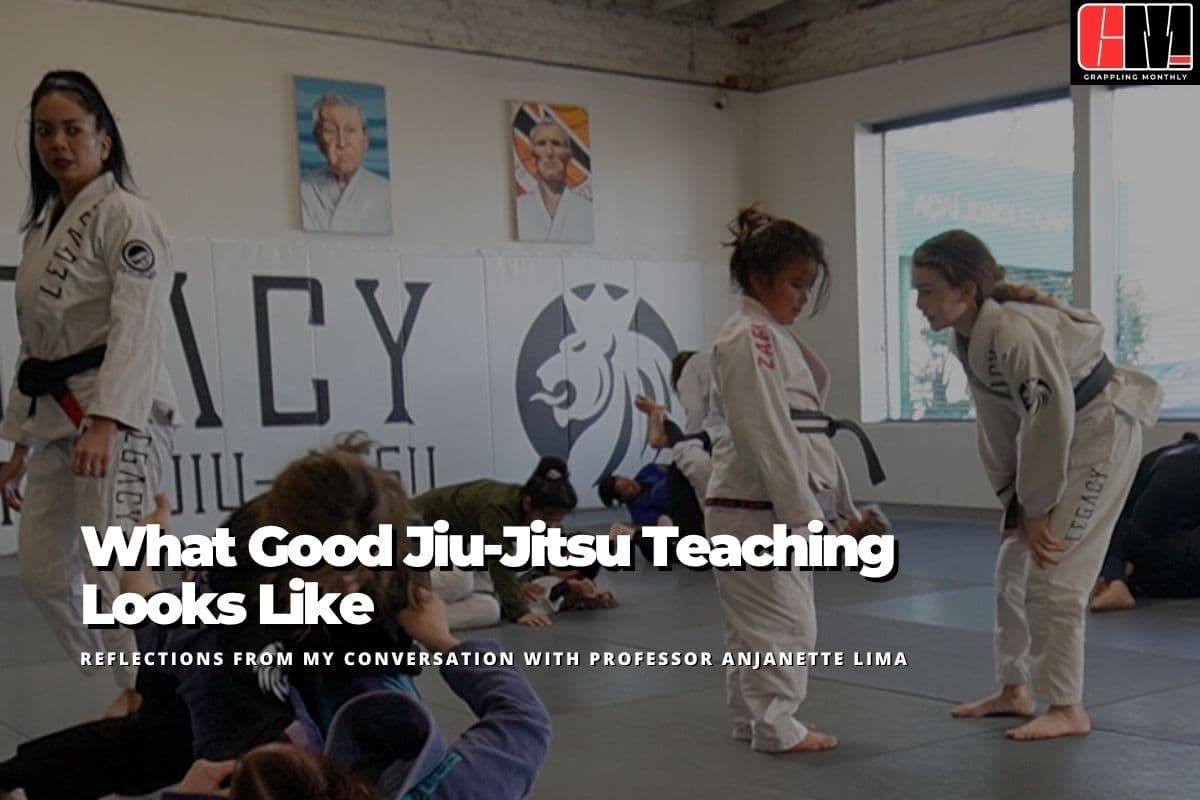
Reflections from my conversation with Professor Anjanette Lima of Legacy BJJ in Burbank, CA.
Talking with Anjanette Lima left me thinking less about her biography and more about her method.
She started Brazilian jiu-jitsu in her mid-30s, came looking for self-defense and fitness, stayed, moved to Los Angeles, found Legacy, and became one of the people who gives the place its shape. None of that is unusual.
What stayed with me was the way she talks about teaching. Not in slogans. Not in abstractions. In specifics. Breathe. Create space. Repeat the movement until it is available under pressure. Give kids language they can actually use. Build classes people can enter without stripping the art of its difficulty.
Three ideas kept surfacing.
Not Selling Confidence as a Mood
When women ask why they should train jiu-jitsu instead of relying on striking, Anjanette's answer is practical. You may not have space to punch. You may be grabbed. You may end up in close contact, mounted, pinned. In that moment, the first problem is not choosing the perfect technique. The first problem is panic.
That is where her emphasis lands. Breathing. Staying calm. Drilling a response until the body recognizes the position instead of treating it like total disaster.
Anyone who has spent time under real pressure in Brazilian jiu-jitsu knows how fast the body stops cooperating. The chest tightens. The mind narrows. A movement you understood two minutes earlier disappears. Knowing an escape is not the same as having it when you need it. A self-defense class that ignores that gap is only half teaching.
Anjanette does not frame jiu-jitsu as a guarantee. She frames it as preparation. Tuck your chin. Bridge. Make space. Do the movement enough times that it survives stress. She is teaching a nervous system how not to collapse the moment pressure arrives.
For women's self-defense, that is a serious argument for training. It is also a useful correction to how people talk about martial arts in general. Technical knowledge matters. So does composure. Without the second, the first stays trapped in theory.
The Vegetables Are Hidden in the Sauce
Adults often assume teaching children is a simpler version of teaching adults. It is not. With very young kids, the material competes with fear, distraction, attachment to parents, short attention spans, and the basic fact that a three-year-old does not care that your terminology is accurate.
What Anjanette described in the Tiny Cranes program was not watered-down jiu-jitsu. It was jiu-jitsu taught through cues a child can actually hold onto. Breakfalls, sprawls, grip breaks, bridge-and-roll escapes -- arriving through names and images that fit the age of the student. "Tackle the giant." "Shark bite." "T-Rex arms."
A child does not need a lecture on mechanics. A child needs a phrase, a visual, a rhythm, and enough repetition for the movement to start making sense. They are still eating vegetables.
The work is not only technical, either. It is behavioral. Stand here. Listen. Wait. Use your voice. Ask for help. If someone is rough with you, create space, respond clearly, involve an adult. Her comments on the bully guard system stayed concrete for a reason: the goal is not to turn kids into tiny action heroes. The goal is to give them a physical and verbal framework they can use if another child puts hands on them.
The staffing piece matters too. Multiple coaches on the mat. Enough adults to support children who need more attention. Enough structure for kids with autism or other special needs to have a fair shot at succeeding in the room. Family-friendly gyms are easy to describe. Classes that actually justify the description are harder to build.
The Art Stays Hard. The Entry Doesn't Have To Be.
Brazilian jiu-jitsu is difficult in ways that do not need embellishment.
The cardio is strange. The contact is intimate. The learning curve is uneven. You can feel physically fine after a break and come back with your timing gone and your lungs missing. You spend long stretches uncomfortable, tired, and confused. None of that needs rewriting.
What interested me in this conversation was the difference between the hardness of the art and the hardness of entering it. Anjanette is not trying to make jiu-jitsu easy. Her own story begins with getting through the warm-up badly enough that she threw up. What she is describing is a way of teaching that lowers avoidable friction.
A women's class where people do not have to negotiate every first experience inside a co-ed room. A kids program that understands some children need time before they will step fully onto the mat. Coaching that accounts for older beginners, scared beginners, less athletic beginners, beginners whose first instinct under pressure is to freeze. Those are ordinary conditions of entry. Treating them seriously is not softness. It is competence.
You don't have to arrive in shape to start jiu-jitsu. You build the conditioning through the practice. You do not need to begin as the strongest person in the room. You learn how to work, breathe, and move with people of different sizes over time. Anjanette even seeks out larger training partners on purpose, so that size stops being abstract and starts becoming familiar.
Good teaching gives people a way in without lying about what they are entering. A student can still be challenged. A child can still be disciplined. A room can still be demanding. The work is in making those demands understandable enough that people can meet them and keep coming back.