
What jiu-jitsu schools actually sell
Technique draws attention to a school. Experience is what makes people build a relationship to it. Professor Bruno Fernandes of Gracie Barra Montreal on fifteen years of building something worth returning to.
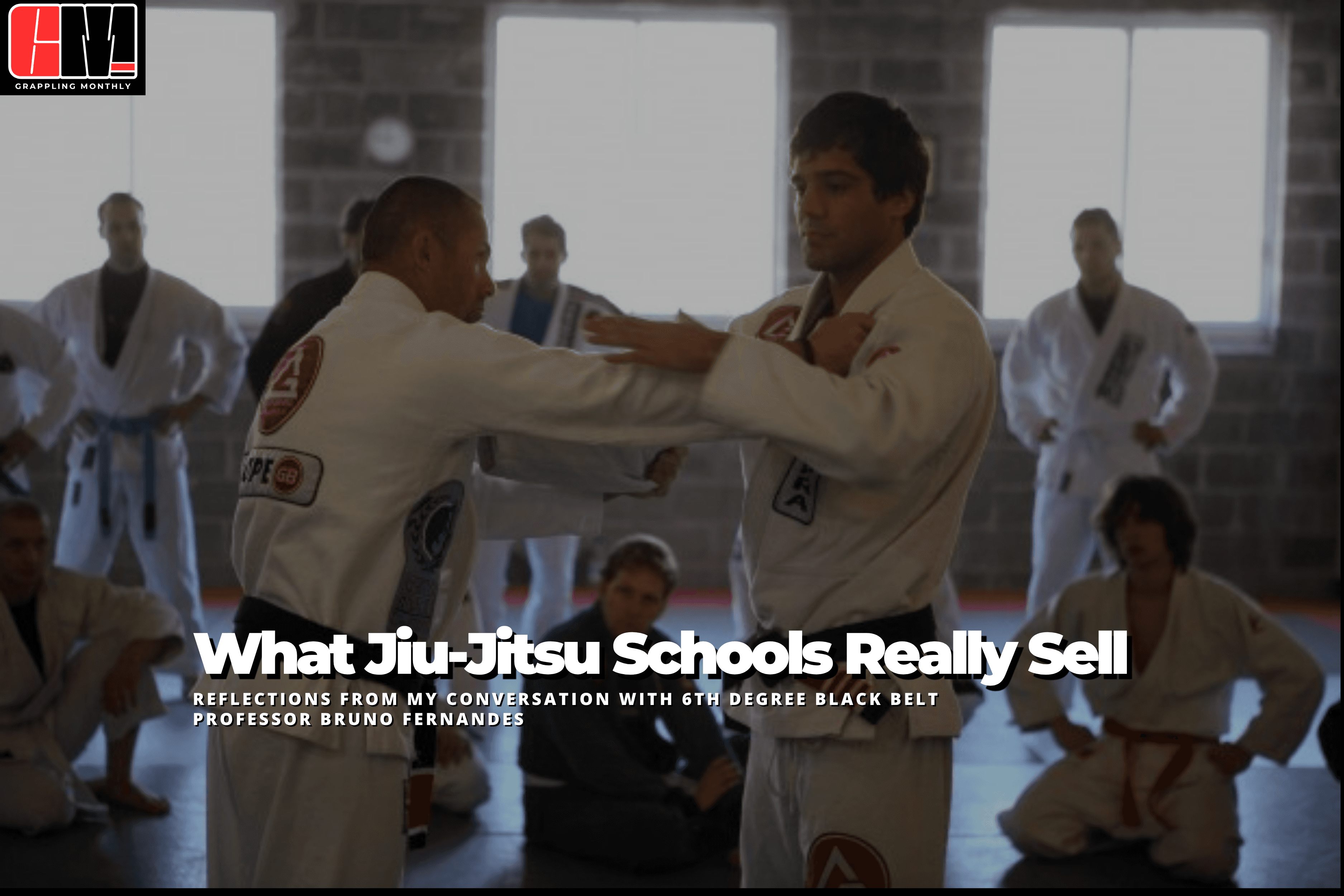
Reflections from a conversation with Professor Bruno Fernandes of Gracie Barra Montreal.
Technique is central to any martial arts academy. If the teaching is poor, students leave, word spreads, and the whole thing collapses. But technique alone does not explain why a school works or why people stay. Professor Bruno Fernandes' account of building Gracie Barra Montreal over fifteen years, and the three decades of training and competing that preceded it, outlines something broader.
In his view, a school sells structure. It sells atmosphere. It sells a standard of experience that people can trust. If those things are in place, technique has somewhere to land.
Where the standard came from
Fernandes started training thirty-six years ago, at age eleven, in Rio de Janeiro. His father had three friends who were Carlson Gracie black belts, and jiu-jitsu became the obvious first pick. He began at the Figeredo academy, the same location where Rolls Gracie once taught and where Carlson Gracie ran his classes on an adjacent mat. Two rooms, two lineages, a bit of rivalry between them, and a depth of talent that is difficult to overstate. Many of the teams that now operate independently trained together in that building before Rolls Gracie's passing scattered the room.
Jiu-jitsu at that time was not a business. It was not even a sport in the way it is now understood. It was a place to learn how to defend yourself, and you had to earn your spot. Fernandes describes the environment plainly. It was tough, it was intimidating, and it was not interested in making things easier for beginners.
He does not romanticize that era. He is proud of the history and clear about its limits. The old model produced a certain kind of toughness, but it also kept people away. It was hard to convince anyone to visit. Talent was missed. People who might have benefited from training never stayed long enough to discover what jiu-jitsu could become for them.
In Fernandes' view, a school is supposed to bring people up. Students have nothing to prove on day one. The school has something to prove: that it can develop whoever walks through the door. That shift in responsibility says a great deal about what a serious academy is trying to provide.
From Tristar to his own school
Fernandes moved through the ranks quickly. Blue belt at sixteen, purple at seventeen, brown at eighteen, black at twenty. He also finished medical school and a residency in Brazil before arriving in Montreal in 2005 to pursue a PhD. What was meant to be a temporary stay turned into a postdoc, then a faculty position at McGill, and eventually a permanent life in Quebec.
He did not come to Canada planning to teach jiu-jitsu. Internet access was limited, and he had no way to research the local scene in advance. He trained sporadically, and eventually connected with the community at Tristar, the renowned MMA gym. There, he began running jiu-jitsu classes alongside fighters competing at the highest levels of MMA.
That environment shaped his teaching. Most of his students at Tristar were not aspiring jiu-jitsu competitors. They were strikers, wrestlers, and mixed martial artists who needed grappling integrated into their existing skill sets. Fernandes had to adapt. He had never trained in any other martial art, had never stepped into a ring, and was candid about that. Rather than prescribe cage strategy, he taught people to think like a jiu-jitsu fighter and let them apply the principles on their own terms. The coaches at Tristar gave feedback in return. The cross-pollination worked because everyone involved kept an open mind about what they did not know.
When it became clear that Montreal would be home for the foreseeable future, Fernandes opened his own school. The early version was simple. He rented a space, put down mats, and opened the doors. No renovations. No elaborate business model. He calculated his rent, figured out how many students he needed to cover it, and grew from there, expanding expenses only when the school could absorb them.
The restaurant test
Over time, the academy grew. More students brought more needs, and more needs brought more complexity. At one point, Fernandes was running a two-story, 5,500-square-foot operation with five or six employees. It was a real business, and he did not enjoy running it. He likes teaching jiu-jitsu. He does not like managing payroll and logistics. So he downsized. Deliberately.
That decision is worth sitting with. A larger school is not automatically a better school. More staff, more square footage, and more systems can solve certain problems, but they can also move the owner further from the mat and closer to the machinery of management. Fernandes chose the version of the school that kept him teaching.
He compares the student experience to going to a restaurant. Nobody cares what management software the kitchen uses. They care whether the food is good, the place is clean, and the staff are welcoming. For a jiu-jitsu academy, the equivalent is straightforward: a clean gym, friendly people, good classes. That formula sounds obvious. It is also easy to lose sight of when energy goes toward brand presentation, scale, affiliation politics, or backend systems while students are evaluating simpler things.
Homegrown staff and the question of standards
Fernandes builds his team from within the school. Instructors, front desk, everyone. The approach is not presented as easier, but as more manageable. A homegrown staff member already understands the culture, the rhythm of the room, and the expectations. They do not need to be taught what the academy is trying to be. They have already lived inside it. Cultural fit, in a small school especially, often matters more than raw competence. Someone can be trained on desk operations. It is harder to integrate a person who disrupts the trust students have come to rely on.
The question of standards across an affiliation follows naturally. Few topics generate stronger reactions in jiu-jitsu. Some practitioners see standards as professionalism and quality control. Others see them as conformity. Fernandes frames it practically. Standards are not there to erase a school's personality. They exist to establish a baseline: cleanliness, consistency, branding, reliability of experience. Within that framework, the school still reflects the owner's temperament and priorities.
Structure and individuality are not mutually exclusive. A school can follow clear operational standards and still feel personal. Even within the same network, different locations develop different emphases. One leans into kids programs, another builds a stronger competition culture, another feels more community-oriented. The shared structure does not flatten those differences. It gives them a common floor.
At scale, that floor matters. When students travel or relocate, recognizable structure reduces uncertainty. A familiar class format, a consistent standard of service, and a clear brand identity all build trust. The student may encounter a different room, a different instructor, a different local personality, but the experience does not feel random. Standards also improve through accumulated feedback. In a network of a thousand schools, problems surface, solutions get tested, and adjustments follow. Standards, in that sense, are less about rigidity than about institutional learning.
What the room provides
Jiu-jitsu forces regular, close, in-person interaction among adults from different backgrounds. Students depend on one another to improve. They spend time together repeatedly, work through discomfort, and develop trust through shared practice. That environment does not arise automatically, but when maintained well, it becomes one of the academy's strongest offerings.
Fernandes spoke about this in a TED talk years ago, and returns to the point in conversation. Isolation and mental health challenges are defining problems of the current moment. Modern life narrows social circles. People work remotely, scroll alone, and gradually lose the in-person connections that once came naturally. Jiu-jitsu offers a corrective. The interaction is forced, the dependence is real, and the dynamic rewards generosity. If you want good training partners, you have to be a good training partner. The self-interest and the communal interest align.
For many adults, especially after marriage, children, career pressures, or relocation, the social dimension becomes one of the most valuable things a school provides. Jiu-jitsu gives people a place where friendships form around something physically and mentally demanding. In that sense, a school is not only selling classes. It is selling a form of social continuity that can be increasingly hard to find elsewhere.
Training for the long run
Fernandes is unsentimental about aging in jiu-jitsu. He does not pretend the body improves indefinitely. He points out that jiu-jitsu loads the body in specific and sometimes lopsided ways. The anterior muscle chains do most of the work. Shoulders roll forward. Hips open in certain directions but tighten in others. Over years, that imbalance creates chronic issues in the spine, the hips, and elsewhere. He links this directly to the injuries he sees among longtime practitioners: problems that could be managed or avoided with deliberate counterbalancing.
This is part of why he values surfing as a complement to jiu-jitsu. In Rio de Janeiro, the connection between the two is social as well as physical. But the physical argument is specific: surfing opens the posterior chain, demands mobility, and works the body in directions that jiu-jitsu neglects. Swimming serves a similar function for those without access to a coastline. The broader principle is that any sustained physical practice benefits from a counterweight.
For older practitioners, his advice is plain. Keep coming. Do not get hurt. There is no need to resist submissions past the point of safety. Nothing matters more than staying healthy enough to return. Mobility work becomes essential, not optional. Give less away positionally, because recovery is slower and the margin for error is thinner.
The harder adjustment is mental. Fernandes is direct about this too. After a certain age, physical decline is real. Students you once introduced to jiu-jitsu will eventually surpass you. The version of yourself you remember from ten years ago is not the version that shows up today. If you keep measuring yourself against what you used to be, the experience turns bitter. If you shift the goal toward durability, toward still being on the mat a decade from now, the math changes. The older black belt who keeps training is not competing against younger versions of themselves. They are ahead of everyone their age who stopped moving.
Deliberate practice still matters at every stage, but the goals should scale to reality. For a newer student, maybe the objective is to get tapped five times instead of six. For an experienced practitioner in their forties, maybe it is to work a specific position or test a concept rather than win every round. The point is to arrive with a plan, measure against that plan, and leave the rest alone.
What the product actually is
A jiu-jitsu school sells technique, and without technical integrity, nothing else holds. But it also sells trust. It sells rhythm. It sells a room that is orderly enough to return to and alive enough to care about. It sells the conditions under which learning becomes possible and sustainable across years.
Students may arrive because they want to learn how to fight, get in shape, compete, or challenge themselves. They stay for more layered reasons. They stay because the place is clean. Because the instruction makes sense. Because the culture feels coherent. Because the people are welcoming. Because the school gives shape to part of their week and, over time, part of their life.
Technique draws attention to a school. Experience is what makes people build a relationship to it. And when that experience is structured well, the academy becomes more than a place where techniques are taught. It becomes a place people keep returning to.

Many thanks to professor Bruno Fernandes for taking the time to share insights and experience from over 30 years of dedication to the art. Tune in to The Grappling Monthly Podcast on YouTube or Spotify to listen to the full interview, or visit Grappling Monthly's website for more content!