
Why People Stay in Jiu-Jitsu
Retention in jiu-jitsu has far less to do with becoming a killer than we like to admit. People stay because the room makes sense in their lives.
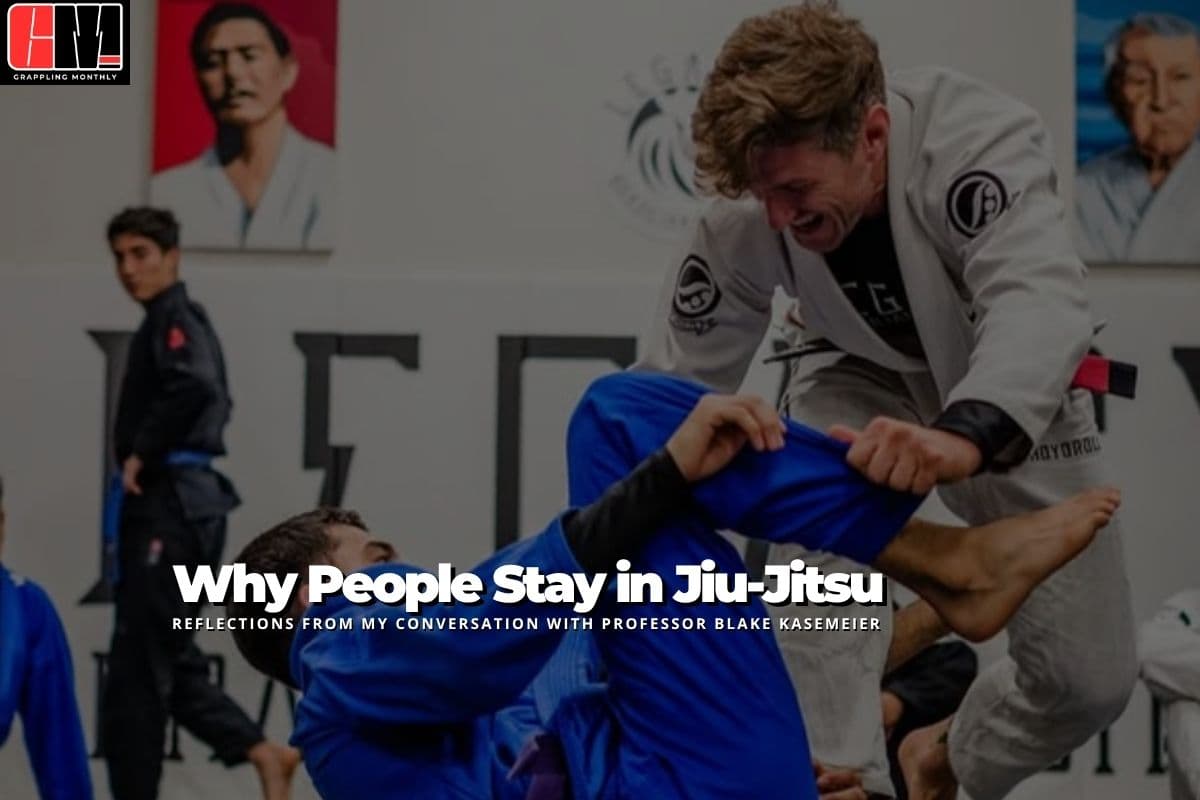
Takeaways from The Grappling Monthly Podcast, Episode 31 with Prof. Blake Kasemeier.
Jiu-jitsu isn't hard. The friction around it is hard.
The training itself is addictive. It's engaging, immediate, and deeply physical. You get to solve problems in real time with another human being who is trying to stop you. That part is compelling.
What's difficult is everything that surrounds it.
Getting out of work on time. Coordinating childcare. The commute. Managing injuries. Paying the monthly fee. Showing up when you're tired.
Retention in jiu-jitsu has far less to do with "becoming a killer" than we like to admit. People stay because the room makes sense in their lives. Because the progress compounds. Because the culture feels worth the friction.
The technique is only part of it.
The Compounding Effect
Most sports reset.
If you cycle, you rebuild fitness every season. You periodize, peak, decline, and repeat. The work matters, but it doesn't stack indefinitely.
Jiu-jitsu stacks.
The first stripe on a white belt is not symbolic. It represents something you can't lose next season. You might get out of shape. You might take time off. But that stripe reflects skill acquisition that compounds.
The same applies at every level: skills layer, timing sharpens, decision-making accelerates, identity stabilizes.
You don't just get better at jiu-jitsu. You become someone who trains.
That distinction matters.
People stay because they feel themselves building something durable. Not just fitness. Not just cardio. A body of knowledge and a version of themselves that accumulates over years.
Compounding progress is addictive.
You Don't Have to Be a Black Belt at Everything
There is a common illusion in jiu-jitsu.
We assume a black belt means technical perfection across hundreds of techniques. In reality, many black belts are blue belts at most individual moves.
What they are black belts at is eliciting reactions.
They understand how to force predictable responses. They recognize decision trees faster. They apply "good enough" mechanics at exactly the right moment.
That shift is crucial.
Beginners try to memorize moves. Intermediates refine mechanics. Advanced practitioners manage reactions.
You don't need to master every technique. You need to master how to create the conditions where simple techniques work.
Retention improves when students understand this early. When the focus shifts from collecting moves to learning how to learn, jiu-jitsu becomes less overwhelming and more navigable. Skill development becomes a transferable process.
Ritual vs. Efficiency
Warm-ups are a small example of a larger truth.
From a purely technical standpoint, you could argue that 15 minutes of generic calisthenics is inefficient. Over four classes per week, that's an hour of potential mat time.
But ritual has value.
Ritual signals entry into a different mode of being. It provides continuity. It builds shared rhythm. It creates something that feels structured in a world that often isn't.
Humans build traditions for a reason.
The key question isn't whether ritual exists. It's whether it serves the room.
A good academy understands both sides: efficiency matters, culture matters, technical growth matters, and so does belonging.
When ritual becomes dogma, it calcifies. When efficiency ignores culture, the room loses cohesion. Retention lives in the balance.
How People Actually Choose a Gym
When someone asks how to pick a jiu-jitsu academy, the decision usually boils down to four variables: schedule, location, culture, and technical quality.
They don't carry equal weight.
A strong culture can overcome an inconvenient location. An ideal location can compensate for a limited schedule. Elite technical instruction can justify longer drives.
But for most people, culture is decisive.
Culture determines whether you come back after a hard day. Culture determines whether you feel safe training. Culture determines how the room responds when someone gets injured.
One subtle indicator of technical quality is whether smaller practitioners can apply the system effectively. If technique works for the physically vulnerable, it's probably sound.
The Uncomfortable Truth
The art can be beautiful and flawed at the same time.
We've seen enough in recent years to know that skill does not equal character. A black belt is not a moral certification.
Some people grow through jiu-jitsu. Some people remain unchanged. A few become more dangerous versions of who they already were.
Loving the art does not require ignoring its failures. In fact, maturity demands the opposite.
What defines a healthy community is not the absence of problems. It is how the room responds when something goes wrong. When someone gets injured and everyone stops to help. When accountability matters more than status. When safety outranks hierarchy.
That response reveals more than any marketing slogan.
What a Good Room Looks Like
Operationally, a good academy has consistent scheduling, maintains clean facilities, sets clear expectations, promotes responsibly, and protects students.
Culturally, a good academy balances tradition with adaptability, encourages growth without ego worship, welcomes hobbyists and competitors alike, allows intensity without toxicity, and makes people want to return.
The best rooms understand that jiu-jitsu is not just about fighting ability. It is a structured space where people manage stress, build identity, and experience compounding progress.
People stay because the room works.
Not because they want to be killers. Not because they want to dominate strangers.
They stay because the friction of life feels manageable inside that structure. And because, week after week, they are building something that lasts.